363
The movie above explains that while standard joints work well for symmetrical loads, an asymmetric load places irregular stresses on the joint.
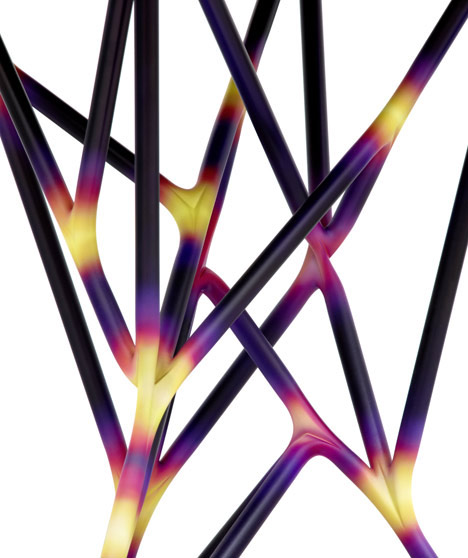
The Multithread process adapts the joint for asymmetric foces, adding support where required by twisting the joint or increasing its mass.
Once finalised, the design is exported as a set of digital blueprints to be 3D printed in a selective laser sintering process, which applies powdered metal in layers to build up a shape.
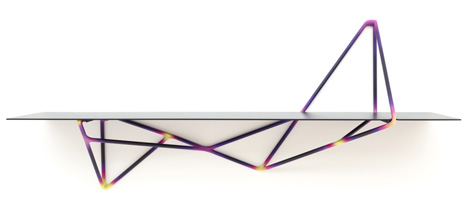
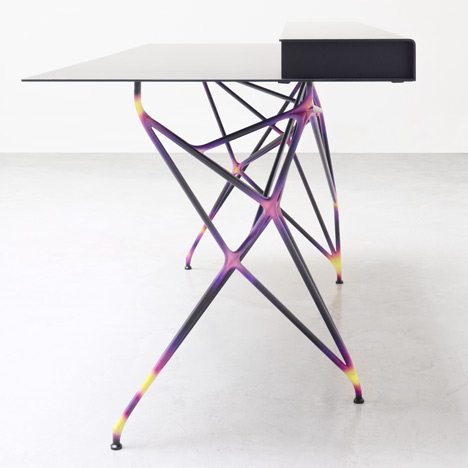
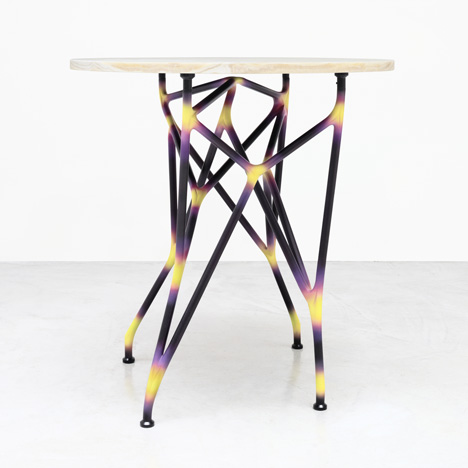
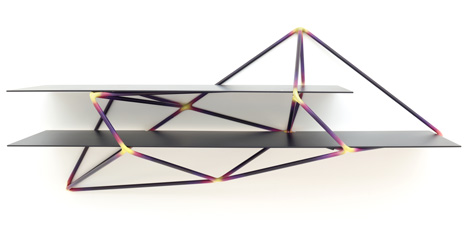
Tubes are CNC-cut to length to connect the finished joints before the base is painted to illustrate the forces at work, with yellow denoting areas under most stress.
Originally created as an installation for Nilafur Gallery in Milan, Multithread is now part of the Adhocracy exhibition at the Istanbul Design Biennial, which continues until 12th December. Exhibition curator Joseph Grima told Dezeen in an interview that new technologies are causing a “cultural revolution” that could transform how objects are made and how they look – read our full interview with Grima.
Swedish designer Reed Kram and German designer Clemens Weisshaar founded their design studio in 2002. Other projects by the designers we’ve featured on Dezeen include a family of interlocking cast concrete objects and an installation of message-writing robotic arms in Trafalgar Square in London.
 ذکر منبع یادتون نره